
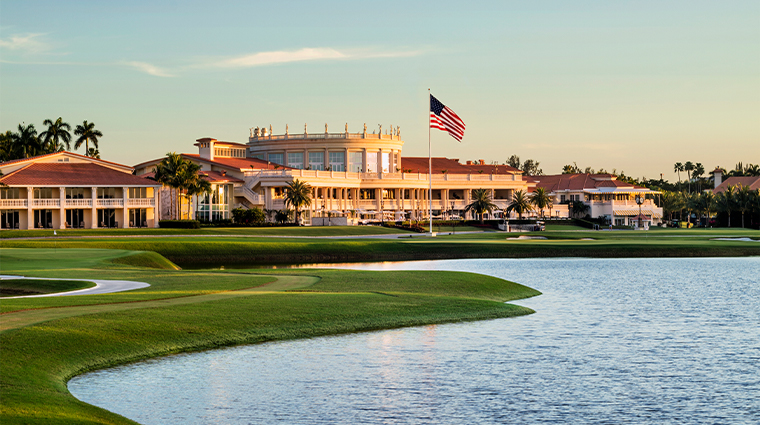
Here’s a comprehensive, in‑depth look at Trump National Doral Miami Golf Club — its history, architecture, amenities, and in particular, its golf courses and signature holes.
🏌️ History & Origins
-
Originally Doral Country Club, the property was developed by Alfred Kaskel and opened in January 1962 as a high‑end resort featuring multiple golf courses and a hotel.
-
In 2012, the Trump Organization acquired the resort for roughly $150 million, rebranding it Trump National Doral, and investing over $250 million in renovations completed by 2016.
-
The resort has since hosted PGA Tour events from 1962–2016 on its iconic Blue Monster course, and more recently LIV Golf tournaments through 2023—with PGA Tour reportedly returning in 2026.
Architecture & Resort Features
- The resort sprawls across around 800 acres, with 643 deluxe rooms and suites, inclusive of presidential and spa suites.
- The Clubhouse, exclusive for members and guests, offers panoramic views of the Blue Monster, upscale dining, locker rooms with steam rooms, and a modern, luxurious design aesthetic.
- Facilities include a 48,000 sq ft spa, Royal Palm Pool with cabanas and slide, LED-lit Har-Tru tennis courts, jogging paths, and a gym with group fitness and golf academy instruction.
- Golf-centered amenities feature the Rick Smith Golf Performance Center, True Spec club‑fitting lab, a 7,000 sq ft pro shop, and a range of dining venues from fine dining (BLT Prime) to casual fare and poolside cafés.
The Four Championship Golf Courses
1. The Blue Monster
- Architectural lineage: Originally designed by Dick Wilson (1961), renovated by Gil Hanse beginning in 2013, reopening in December 2013 at approximately 7,510 yards.
- Par 72 layout: Historically hosted PGA Tour events (WGC‑Cadillac Championship through 2016). Yardage ranged from 7,481 to 7,528 yd across recent events (2014–16).
-
Key holes:
- Hole 1: Long par‑5 opener (~590 yd in later layouts) setting tone for length.
- Hole 2: Shorter par‑4 (~448 yd) but visually intimidating; favor a tee shot that hugs right bunker to set up approach.
- Hole 3: Dogleg right around a lake; drive must navigate hazards to access greener angle; a strong risk‑reward hole (~440 yd).
- Other notable features include water hazards on 14 holes, small elevated greens, large bunker complexes, and scoring difficulty enhanced by renovated contours and length.
- Playing challenge: Hans e’s redesign reinstated Dick Wilson's intended difficulty—lengthened tees, more lakes, tighter corridors, and greens shaped with more undulation to challenge tour‑level players and amateurs alike.
2. Golden Palm (formerly Gold Course)
-
Originally redesigned by Raymond Floyd in 1995, renamed Golden Palm in 2012, then fully renovated by Gil Hanse/Jim Wagner in 2015.
-
Layout features a classic 18 holes, offering length, strategic bunkering, and water, but typically considered more playable than the Blue Monster—balanced par‑5s and varied par‑3s and par‑4s.
3. Silver Fox
-
Formerly the Jim McLean Signature Course; transformed into Silver Fox, reopening in late 2014.
-
Unique format includes six par‑5s, six par‑4s, six par‑3s—a creative twist on traditional layouts; players encounter diverse hole lengths and strategic challenges.
4. Red Tiger
-
Though less documented, this course is known for its 14 water hazard holes, hilly terrain inspired by New England-style design, and was renovated by Gil Hanse. It adds variety and scenic contrast to the resort’s collection.
Notable Features & Layout Summary
| Course | Par | Yardage Range | Distinctive Character |
|---|---|---|---|
| Blue Monster | 72 | ~7,480–7,528 yd | Classic PGA Tour course, lengthy, water‑lined, strategic |
| Golden Palm | 72 | Approx. Championship length | Balanced design, playable but tactically subtle |
| Silver Fox | 72 | Mixed lengths | Unconventional 6‑6‑6 hole mix |
| Red Tiger | 72 | Mid‑range | Water hazards, elevation changes, visual charm |
-
Combined, the resort offers 72 championship holes, extensively renovated by Gil Hanse to modern standards of aesthetics, playability, and environmental conditioning.
Architectural Notoriety
- The original Doral layout, especially the Blue Monster, was legendary on the PGA Tour for decades.
- Under Trump’s ownership, Gil Hanse and his team meticulously restored and modernized all courses, planting thousands of trees, re‑sculpting greens, expanding lakes, and lengthening tees to challenge modern players.
- The Blue Monster’s significance is reinforced by its long run as a PGA venue, its dramatic redesign, and its return to professional competition under LIV Golf and potential PGA rebirth in 2026.
Amenities & Visitor Experience
- Membership gives access to all four courses, state-of-the-art practice facilities, clubhouse amenities, spa and pool access, tennis, dining, and more.
- Non-members may experience the resort through stay‑and‑play packages, golf vacations, or lessons at the Rick Smith Performance Center and club fitting at True Spec.
- Upscale dining options include BLT Prime, Champions Bar & Grill, Palm Grill, and Marketplace Café, catering to everything from steak dinners to poolside snacks.
Trump National Doral Miami stands as one of America’s most historic and architecturally significant golf resorts. From its 1962 origins and decades of PGA Tour history to modern reinvigoration by Gil Hanse, it now offers four pristine championship courses, world‑class facilities, luxury lodging, and a design-first focus across amenities and hospitality.